 Opening mugs
 Posters
 Desk mats
 Coasters & stickers
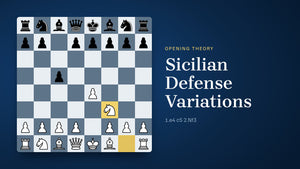


The main Sicilian Defense variations are decided by Black's second move after 1.e4 c5 2.Nf3, with 2...d6, 2...Nc6, 2...e6 and 2...g6 each leading to its own family of systems, and every choice also has to handle White's anti-Sicilians.
In this guide
How to choose among Sicilian Defense variations
The Sicilian, 1.e4 c5, is not one opening but a large family. The number of Sicilian Defense variations can feel overwhelming, but the choice becomes manageable if you organise it around a single decision: Black's second move after 2.Nf3.

After 2.Nf3, Black usually plays one of four moves: 2...d6, 2...Nc6, 2...e6 or 2...g6. Each one keeps some systems available and rules others out. White then normally opens the centre with 3.d4 and, after the exchange on d4, recaptures with the knight, the Open Sicilian. The rest of this guide follows that tree, branch by branch, with the Lichess names and ECO codes for each main line.
One practical point before choosing: whatever you play after 2.Nf3, you must also be ready for the anti-Sicilians, the lines in which White avoids the Open Sicilian altogether. They are covered later in the guide.
Black plays 2...d6
The pawn on d6 keeps the e5 square under control and prepares the knight to f6. After 3.d4 cxd4 4.Nxd4 Nf6 5.Nc3, Black's fifth move chooses the system.
5...a6 is the Najdorf (B90), described by Wikipedia as Black's most popular system. The quiet pawn move controls b5 and keeps Black's plans flexible; White's main weapon against it is 6.Be3, the English Attack. Our Najdorf guide covers it in depth.
5...g6 is the Dragon (B70), with the bishop fianchettoed on g7. White's most dangerous plan is the Yugoslav Attack, 6.Be3 Bg7 7.f3 O-O 8.Qd2 Nc6, which Wikipedia describes as "ferociously complicated". See our Dragon guide for the plans.
5...Nc6 is the Classical Variation (B56), usually met by 6.Bg5, the Richter-Rauzer. 5...e6 is the Scheveningen (B80), in which the pawn on e6 guards d5; Paul Keres introduced the aggressive 6.g4 against it in 1943.
The Sicilian Defense mug prints the opening's name and the board diagram of the position after 1.e4 c5 on both sides: the starting point of every variation in this guide.
Black plays 2...Nc6
Developing the knight first keeps the d-pawn flexible. After 3.d4 cxd4 4.Nxd4, the main branches are:
4...Nf6 5.Nc3 e5, the Lasker-Pelikan Variation (B33), which Evgeny Sveshnikov and Gennady Timoshchenko developed in the 1970s into what is now called the Sveshnikov. Wikipedia describes it as "extremely popular among grandmasters and amateurs alike". Black accepts a hole on d5 in exchange for active pieces.
4...g6 is the Accelerated Dragon (B32). Black delays the pawn move to d6 so that the central break with the d-pawn can come in one move. The critical test is 5.c4, the Maróczy Bind (B36), in which White uses pawns on c4 and e4 to restrain Black.
4...e5 5.Nb5 d6 is the Kalashnikov (B32), a relative of the Sveshnikov revived in the late 1980s.
The price of 2...Nc6 is that White can avoid all of this with 3.Bb5, the Rossolimo (B30), which Wikipedia calls a well-respected alternative to 3.d4. White usually plans to take on c6 and double Black's pawns. Retreating the bishop instead can be dangerous, as our article on the Noah's Ark Trap shows.
Black plays 2...e6
The pawn on e6 prepares a later central advance with the d-pawn and opens a diagonal for the dark-squared bishop. After 3.d4 cxd4 4.Nxd4, Black's main choices are:
4...Nc6, the Taimanov (B44), which develops the knight to its natural square. 4...a6, the Kan (B41), also called the Paulsen, which prevents the knight jump to b5 and prepares a queenside expansion with the b-pawn. 4...Nf6 5.Nc3 Nc6, the Four Knights (B45), which Wikipedia notes lets Black avoid lines such as the Rossolimo.
The e6 systems tend to be flexible and less forcing than the Najdorf or the Dragon, which suits players who prefer understanding structures to memorising long lines.
Black plays 2...g6
The earliest fianchetto is the Hyper-Accelerated Dragon, 2...g6, and after 3.d4 cxd4 Lichess classifies the position as B27. Black aims for the Dragon bishop on g7 while keeping both the d-pawn and the knight on b8 flexible. The details, including the 4.Qxd4 line and the Maróczy Bind, are in our Hyper-Accelerated Dragon guide.
The anti-Sicilians every choice must handle
Many White players avoid the Open Sicilian. Whichever system you choose, you need an answer to the following.
| Anti-Sicilian | Moves | Typical replies and notes |
|---|---|---|
| Alapin (B22) | 1.e4 c5 2.c3 | 2...d5 or 2...Nf6 |
| Closed Sicilian (B23) | 1.e4 c5 2.Nc3 | Main line 2...Nc6 3.g3 g6 4.Bg2 Bg7 5.d3 d6 |
| Smith-Morra Gambit (B21) | 1.e4 c5 2.d4 cxd4 3.c3 | Accepting with 3...dxc3 is considered critical |
| Grand Prix Attack (B21) | 1.e4 c5 2.f4 | 2...d5 is considered Black's best reply |
| Rossolimo (B30) | 1.e4 c5 2.Nf3 Nc6 3.Bb5 | Only after 2...Nc6 |
| Moscow Variation (B51) | 1.e4 c5 2.Nf3 d6 3.Bb5+ | Only after 2...d6; 3...Bd7 is the most common reply |
The table also shows a hidden cost of each second move. 2...Nc6 allows the Rossolimo, 2...d6 allows the Moscow, and 2...e6 sidesteps both. The Smith-Morra deserves special attention because, as Wikipedia notes, it contains traps for the unwary; our Smith-Morra guide covers it from both sides.
The two most famous branches of 2...d6, side by side: the Najdorf after 5...a6 and the Dragon after 5...g6. Two mugs are 10% off automatically at checkout, three or more 15%.
A decision map
Choosing between Sicilian Defense variations is easier if you match them to how you like to play.
| If you prefer... | Consider | Why |
|---|---|---|
| Maximum fighting chances and deep theory | Najdorf | Flexible plans and the most popular main line |
| A clear attacking plan on opposite wings | Dragon | The bishop on g7 and play on the c-file |
| Active pieces in exchange for structure | Sveshnikov | Accepts the hole on d5 for piece activity |
| Flexible development and fewer forced lines | Taimanov or Kan | Structures matter more than memory |
| A fianchetto without the pawn on d6 | Accelerated or Hyper-Accelerated Dragon | The central break can come in one move |
If you are on the other side of the board, our article on the best counters to the Sicilian looks at the choice from White's point of view.
Questions
What are the main Sicilian Defense variations?
After 1.e4 c5 2.Nf3, the main systems are the Najdorf, Dragon, Classical and Scheveningen after 2...d6, the Sveshnikov and Accelerated Dragon after 2...Nc6, the Taimanov and Kan after 2...e6, and the Hyper-Accelerated Dragon after 2...g6.
Which Sicilian variation is the most popular?
Wikipedia describes the Najdorf, 5...a6, as Black's most popular system in the Open Sicilian.
Which Sicilian is easiest to learn?
Systems based on 2...e6, such as the Taimanov and the Kan, are generally less forcing than the Najdorf or the Dragon, so understanding the structures matters more than memorising long lines.
What is an anti-Sicilian?
A line in which White avoids the Open Sicilian, such as the Alapin 2.c3, the Closed Sicilian 2.Nc3, the Smith-Morra Gambit 2.d4 cxd4 3.c3 or the Rossolimo 3.Bb5.