 Opening mugs
 Posters
 Desk mats
 Coasters & stickers
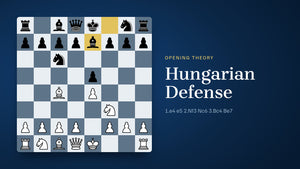


The Noah's Ark Trap is a Ruy Lopez trick in which Black's pawns on a6, b5 and c4 shut White's bishop in on b3, and it only works if White recaptures on d4 with the queen at move eight, so 8.Bd5 or 8.c3 keeps White safe.
In this guide
What the Noah's Ark Trap is
The Noah's Ark Trap is one of the oldest traps in the Ruy Lopez. White's light-squared bishop, the piece that defines the opening after 1.e4 e5 2.Nf3 Nc6 3.Bb5, retreats to b3 and is then surrounded by three black pawns on a6, b5 and c4. Every square it could use is either occupied or attacked, and White has to give it up for one or two pawns.
Nobody knows for certain where the name comes from. One explanation is that the curved chain of pawns on a6, b5 and c4 looks like the hull of an ark. The other is a joke: the trap is supposed to be as old as Noah's Ark. The chess historian Edward Winter traced the idea back at least to an 1876 annotation of the game MacDonnell v Wisker, London, which already warned White not to win the d-pawn with the queen because the black c-pawn would advance twice and trap the bishop.
It has caught strong players too. In Endre Steiner v José Raúl Capablanca, Budapest 1929, White walked into the main line and Capablanca won the game.
The move order that sets it up
The trap grows out of the Modern Steinitz Defense, where Black answers the Ruy Lopez with an early pawn to d6. The critical sequence is 1.e4 e5 2.Nf3 Nc6 3.Bb5 a6 4.Ba4 d6 5.d4 b5 6.Bb3. White has struck in the centre at once, and Black has kicked the bishop back to b3 with the b-pawn.
Now Black exchanges in the centre: 6...Nxd4 7.Nxd4 exd4. White is a pawn down for a moment and the natural reaction is to take it back with the queen, which looks active and centralised. That recapture, 8.Qxd4, is the mistake. The queen stands on d4, where a black pawn can attack it with gain of time, and the bishop on b3 has only a few squares left.
Lichess classifies the position after 8.Qxd4 and Black's reply as C71, under the name "Ruy Lopez: Noah's Ark Trap". Before reading on, look at the position below and try to find Black's move.
Sunday puzzle: bury the bishop
Set up the position after 1.e4 e5 2.Nf3 Nc6 3.Bb5 a6 4.Ba4 d6 5.d4 b5 6.Bb3 Nxd4 7.Nxd4 exd4 8.Qxd4. Black to play. Material is level, but one of White's pieces is in danger. Find the pawn move that starts the trap and the follow-up that finishes it.

Solution: 8...c5! The pawn attacks the queen, so White has no time to rescue the bishop. The most testing reply is 9.Qd5, which attacks the rook on a8 along the long diagonal. Black must be patient: 9...c4? 10.Qxa8 wins the rook, because the bishop on c8 blocks the black queen's defense of a8.
Instead Black first develops with tempo: 9...Be6 10.Qc6+ Bd7 11.Qd5 c4. The bishop has left c8, so the queen on d8 now guards a8, and the c-pawn has arrived. The bishop on b3 is trapped. If White tries 12.Qxa8, then 12...Qxa8 wins the queen for a rook.

The Ruy Lopez mug prints the opening's name and the board diagram of the position after 3.Bb5 on both sides, with the Chess4pro logo between them: the moment the bishop starts the journey that ends on b3.
Why the bishop has nowhere to go
Look at the bishop on b3 after 11...c4. It has four diagonal neighbours. The square a2 is blocked by White's own pawn, and so is c2. The square c4 holds the black pawn that attacks it. The square a4 is covered by the pawn on b5. Further along the diagonals, every route starts with one of those four squares, so the bishop is frozen.
White's best practical choice is to give the bishop for as many pawns as possible: 12.Bxc4 bxc4 13.Qxc4. White has two pawns for the piece, which is not enough in a normal middlegame. Any other move simply loses the bishop to the pawn on c4.
The structure explains why the trap needs three ingredients. The pawn on a6 supports b5, the pawn on b5 supports c4 and covers a4, and the pawn on c4 attacks the bishop. Remove any one of them and the bishop escapes. That is also why the pattern returns in other openings: a bishop on b3 with White pawns still on a2 and c2 is always a candidate for this kind of cage. For the other ways to win material in the opening, see our guide to essential chess tactics.
How White avoids the Noah's Ark Trap
There are two moments where White can step aside. The first is move five: instead of the early central strike, quieter moves keep the bishop out of reach of the pawns. The second is move eight, after the exchanges on d4, where White can recover the pawn without putting the queen on d4.
| Move | Idea | What happens |
|---|---|---|
| 5.c3 | Support d4 before pushing it | Avoids the trap; listed as a better try than 5.d4 in Wikipedia's summary |
| 5.Bxc6+ | Give up the bishop pair at once | The bishop can no longer be trapped; Black gets doubled c-pawns |
| 5.O-O | Castle first, decide later | Avoids the trap and keeps flexibility |
| 8.Qxd4? | Recapture with the queen | 8...c5! and the Noah's Ark Trap closes |
| 8.Bd5 | Hit the rook on a8 first | White regains the pawn with level material |
| 8.c3 | Offer a gambit pawn | White plays for development and open lines |
The cleanest of these is 8.Bd5. The bishop leaves b3 before the pawns arrive and attacks the rook on a8. A natural sequence is 8...Rb8 9.Bc6+ Bd7 10.Bxd7+ Qxd7 11.Qxd4. Now the queen recaptures safely, because the bishop is no longer on b3 to be trapped, and material is level.
If you play the Ruy Lopez as White, the habit to build is simple: before you recapture a pawn in the centre, ask where your b3 bishop goes if Black pushes the c-pawn twice. Our Ruy Lopez guide explains the opening's main ideas.
The same cage in the Sicilian
The pattern is not limited to 1.e4 e5. In the Rossolimo Sicilian, after 1.e4 c5 2.Nf3 Nc6 3.Bb5 a6, the bishop can be trapped in exactly the same way if White retreats it. After 4.Ba4 b5 5.Bb3 c4, the bishop on b3 is surrounded by pawns on a6, b5 and c4 again, and here Black's c-pawn arrives even faster because it started on c5.
The best White can do then is 6.Bxc4 bxc4, a single pawn for the bishop. That is why, in the Rossolimo, White usually takes on c6 with 4.Bxc6: giving up the bishop for a knight is the point of 3.Bb5 in that line, and retreating it only invites the cage.
For a Ruy Lopez player's desk and wall: the mug with the position after 3.Bb5, and the poster, which adds the opening's main line and ECO code, in 12×16 in ($32) or 18×24 in ($45), unframed. Mugs bought together are discounted automatically at checkout: 10% for two, 15% for three or more.
What to remember at the board
For White, the Noah's Ark Trap teaches that a centralised queen is not automatically a well-placed queen. On d4 it can be attacked by a pawn, and while it moves, Black's pawns gain the two tempi they need. Recapturing with the bishop first, or not opening the centre so early, removes the danger.
For Black, the trap is a reason to know the Modern Steinitz move order well. It does not appear in every game, but it costs nothing to keep in mind: if White's bishop sits on b3 and the c-pawn can reach c4 with tempo, look for the cage. The same alertness helps against the other opening tricks collected in our list of the deadliest chess opening traps, and in last week's puzzle on the Blackburne Shilling Gambit.
A final detail worth repeating: the order of Black's moves matters. Playing the c-pawn to c4 before the rook on a8 is protected allows Qd5 and Qxa8. The bishop moves to e6 and d7 are not decoration; they free the back rank so the queen guards the rook.
Questions
What is the Noah's Ark Trap in chess?
It is a Ruy Lopez trap in which Black's pawns on a6, b5 and c4 surround White's bishop on b3. It usually arises after 8.Qxd4 c5 in the Modern Steinitz Defense, when the bishop can no longer escape.
Why is it called the Noah's Ark Trap?
The origin is uncertain. One theory says the pawn chain looks like an ark; the other says the trap is as old as Noah's Ark. Edward Winter found the idea in an annotation from 1876.
How does White avoid the Noah's Ark Trap?
Do not recapture on d4 with the queen at move eight. 8.Bd5 attacks the rook on a8 and lets White regain the pawn safely, and 8.c3 is a gambit alternative. Earlier, 5.c3 or 5.O-O avoids the line altogether.
Can the same trap happen in the Sicilian?
Yes. In the Rossolimo, 1.e4 c5 2.Nf3 Nc6 3.Bb5 a6 4.Ba4 b5 5.Bb3 c4 traps the bishop in the same way. That is why White normally plays 4.Bxc6 there.