
The Ultimate Guide to the Caro-Kann Defense for Club Players

Facing 1.e4 can be a daunting experience for Black. White immediately stakes a claim in the center and prepares rapid piece development. If you are tired of memorizing endless, razor-sharp tactical lines in the Sicilian Defense, or defending the symmetrical struggles of 1...e5, there is a legendary weapon favored by World Champions like Anatoly Karpov and Jose Raul Capablanca.
Enter the Caro-Kann Defense. Known as the "Accountant's Opening" for its strict, structural reliability, the Caro-Kann is a hyper-solid response that aims to neutralize White's early aggression and drag them into a strategically complex middlegame where pawn structures dictate the rules.
Quick Answer: What is the Caro-Kann Defense?
The Caro-Kann Defense is a chess opening for Black characterized by the moves 1. e4 c6. Its primary goal is to support a strong pawn push to d5 on move two, challenging White's central control without blocking the development of Black's light-squared bishop. It is renowned for leading to exceptionally solid pawn structures and favorable endgames for Black.
1. The Philosophy of the Caro-Kann
When you play 1...c6, you are making a clear statement: "I will not be checkmated in 20 moves." Unlike the Sicilian Defense, where Black creates immediate imbalances, the Caro-Kann focuses on extreme solidity. The move 1...c6 prepares 2...d5, challenging the center safely.
The greatest advantage of the Caro-Kann is that it allows Black to develop the light-squared bishop (usually to f5 or g4) before closing the pawn chain with e6. This solves the "bad bishop" problem that notoriously plagues other solid openings.
Show Your Solidity: The Caro-Kann Defense Mug
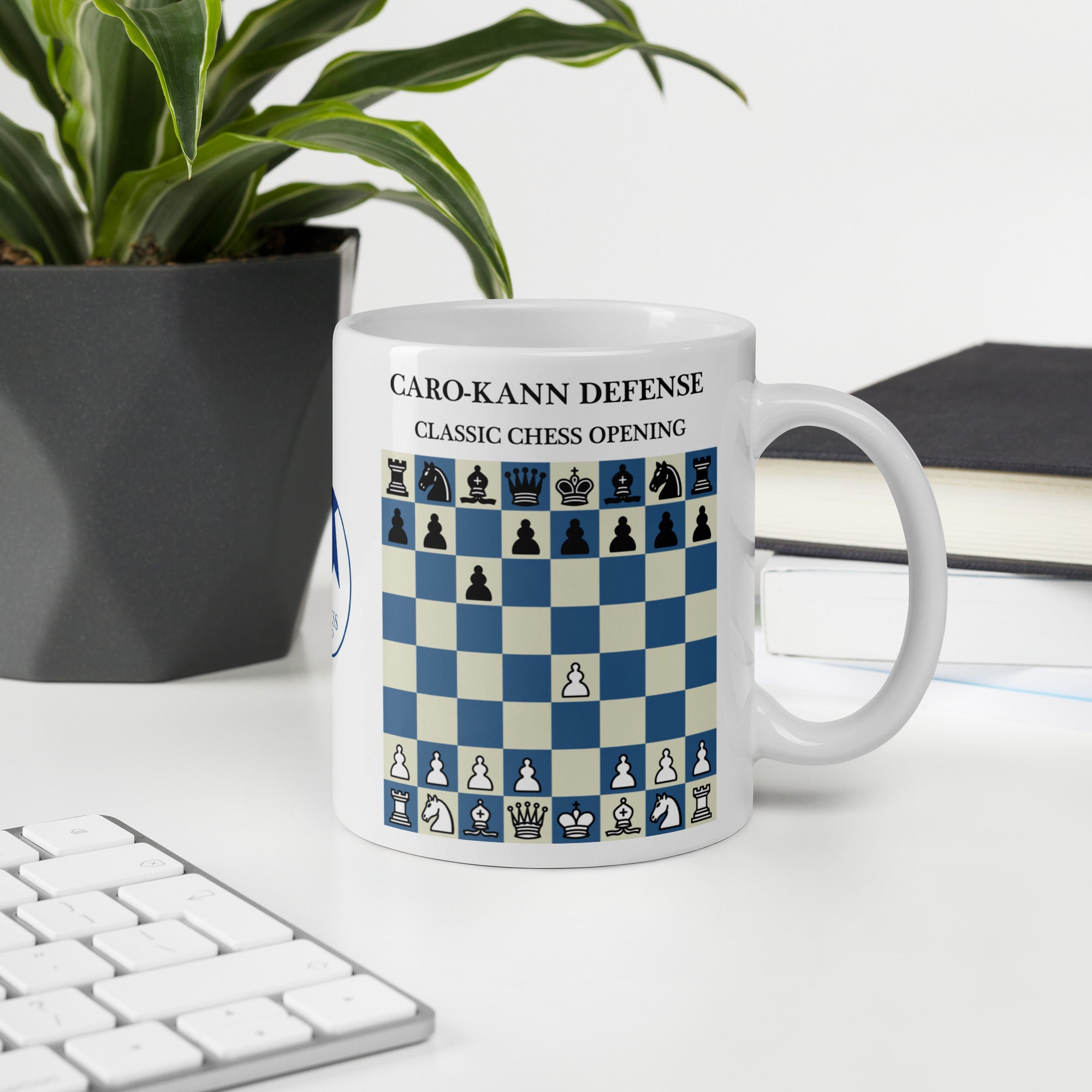
Memorize the critical pawn structures of the Advance Variation with your morning coffee. Our Caro-Kann Defense Mug is the perfect daily reminder of your iron-clad opening repertoire.
GET THE CARO-KANN MUG2. Main Variations Explained
After 1.e4 c6 2.d4 d5, White has to make a crucial decision about the e4 pawn. How White reacts will dictate the flavor of the entire game.
| Variation Name | Starting Moves | White's Goal | Black's Strategy |
|---|---|---|---|
| The Advance Variation | 1.e4 c6 2.d4 d5 3.e5 | Gain massive space in the center and kingside. Restrict Black's piece mobility. | Develop the Bishop to f5 quickly, then strike White's center with c5. |
| The Exchange Variation | 1.e4 c6 2.d4 d5 3.exd5 cxd5 | Create a symmetrical, quiet position. Often followed by the aggressive Panov-Botvinnik Attack (4.c4). | Control the center, develop naturally, and look to exploit isolated pawns if White plays c4. |
| The Classical Variation | 1.e4 c6 2.d4 d5 3.Nc3 dxe4 | Recapture the pawn (4.Nxe4) and maintain flexible, centralized knights. | Challenge White's centralized knight immediately with 4...Bf5 or 4...Nd7. |
3. Caro-Kann vs. French Defense: Choose Your Weapon
Club players constantly debate between the Caro-Kann (1...c6) and the French Defense (1...e6). Both are incredibly solid responses to 1.e4, but their fundamental structures differ significantly.
- The Bishop Problem: In the French Defense, playing 1...e6 immediately blocks Black's light-squared bishop, turning it into a passive defender for most of the middlegame. The Caro-Kann plays 1...c6 to allow that same bishop to jump to f5 or g4 before playing e6.
- The Counter-Attack: The French Defense generates incredibly fast counter-play against White's center with moves like c5. The Caro-Kann is slightly slower, requiring more patience but resulting in fewer early tactical blunders.

4. Common Traps to Avoid
Despite being a fortress, the Caro-Kann has a few early tactical pitfalls that beginners fall into.
The Smothered Mate Trap: In the Classical variation (1.e4 c6 2.d4 d5 3.Nc3 dxe4 4.Nxe4), if Black plays 4...Nd7 (the Karpov variation), White might try the sneaky 5.Qe2. If Black plays carelessly with 5...Ngf6??, White delivers a shocking checkmate with 6.Nd6#. The pawn on e7 is pinned by the Queen!
5. How to Study the Caro-Kann Properly
Because the Caro-Kann is heavily focused on pawn structures and endgame transitions, studying it on a 2D digital screen is highly inefficient. You need to physically feel the space limitations in the Advance Variation and visualize the pawn breaks.
6. Frequently Asked Questions (FAQ)
Yes, it is excellent for beginners. It teaches fundamental concepts like pawn structure, safe piece development, and how to reach an endgame without blundering material in the first 15 moves.
The opening is named after the English player Horatio Caro and the Austrian player Marcus Kann, who jointly analyzed and published theory regarding the opening in the late 19th century.
While it is very solid and leads to many draws at the Grandmaster level, at the club level (ELO 800-2000), it offers plenty of winning chances. White players often get frustrated by the solid structure and overextend their attacks, allowing Black to win through counter-play.
Conclusion
The Caro-Kann Defense is a lifelong weapon. The structures you learn at ELO 1000 will still serve you when you reach ELO 2000. Embrace the solidity, study the endgames, and watch as aggressive White players crumble against your iron wall.
Keep Your Repertoire in Sight
41 ceramic mugs printed to order, each with the name and diagram of a classic opening.