 Opening mugs
 Posters
 Desk mats
 Coasters & stickers
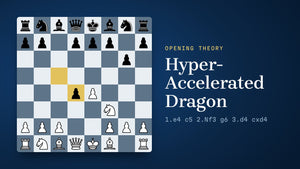


The Hyper-Accelerated Dragon (1.e4 c5 2.Nf3 g6) puts the bishop on g7 before Black commits the b8 knight or the d-pawn, which sidesteps the Rossolimo, keeps the ...d5 break available in one move and lets Black meet 4.Qxd4 with gain of time.
In this guide
What the Hyper-Accelerated Dragon is
The Hyper-Accelerated Dragon is a Sicilian move order for Black: 1.e4 c5 2.Nf3 g6. After the most common continuation, 3.d4 cxd4, we reach the position printed on the Chess4pro mug of the same name. The Lichess opening database files it under code B27 as the "Hyperaccelerated Dragon"; both spellings refer to the same line.
The family resemblance to the Dragon is the fianchetto: Black's bishop goes to g7 and bears down the long diagonal towards d4 and b2. What is different is timing. In the classical Dragon, Black plays ...d6 and ...Nf6 first, and only then ...g6. In the Accelerated Dragon, ...Nc6 comes before ...g6. In the Hyper-Accelerated Dragon, ...g6 comes before everything.
Why ...g6 on move two
Move orders in the Sicilian are about what you allow and what you avoid. Playing 2...g6 at once has three concrete consequences.
First, it avoids the Rossolimo. After 1.e4 c5 2.Nf3 Nc6 3.Bb5, White pins or exchanges the knight and many Dragon players dislike the resulting positions. With the knight still on b8, 3.Bb5 attacks nothing.
Second, the d-pawn has not moved yet. That keeps the option of ...d7-d5 in a single move, which becomes important when White chooses the aggressive set-up with f3, Qd2 and long castling.
Third, White gets an extra option that does not exist in other move orders: recapturing on d4 with the queen. That is the main practical difference, and it is less dangerous than it looks.
| Move order | Moves | Allows 3.Bb5 | Allows Qxd4 safely |
|---|---|---|---|
| Dragon | 2...d6, then ...Nf6 and ...g6 | Yes (as 3.Bb5+) | Yes, after 3.d4 cxd4 4.Qxd4 |
| Accelerated Dragon | 2...Nc6, then ...g6 | Yes (Rossolimo) | No, the c6 knight covers d4 |
| Hyper-Accelerated Dragon | 2...g6 | No target | Yes, met by 4...Nf6 |
4.Qxd4: the queen hits h8
After 3.d4 cxd4 4.Qxd4 the queen does more than recapture. Because Black has already played ...g6 but not yet ...Bg7, the diagonal from d4 to h8 is open and the queen attacks the rook in the corner.

The answer is 4...Nf6, which blocks the diagonal while developing. White usually tries to chase the knight with 5.e5, and Black replies 5...Nc6, hitting the queen. After 6.Qa4 Nd5 the knight sits in the centre, Black has developed two pieces with tempo and the e5 pawn needs looking after. This is the standard way to handle 4.Qxd4, and it is the reason the early queen move rarely scares experienced players of this line.
The lesson generalises: when an opponent centralises the queen early, look for developing moves that attack it. Each tempo White spends moving the queen is a tempo Black spends on development.
4.Nxd4 Nc6: into the Accelerated Dragon
The main line is 4.Nxd4 Nc6, and here the Hyper-Accelerated Dragon transposes. The position is identical to 1.e4 c5 2.Nf3 Nc6 3.d4 cxd4 4.Nxd4 g6, the Accelerated Dragon. From this point you are playing the same theory, with one difference in your favour: the Rossolimo never happened.
White now chooses between two broad strategies: clamp the centre with c4 (the Maróczy Bind) or develop with Nc3 and fight in the open Sicilian manner. A third option, 5.Nxc6 bxc6, gives Black an extra central pawn on c6 and a half-open b-file. Here 6.Qd4 again hits h8, and 6...Nf6 7.e5 Nd5 follows the same blocking idea as in the 4.Qxd4 line.
The Hyper-Accelerated Dragon mug prints the opening's name and the diagram after 3...cxd4, the moment Black's early fianchetto meets White's central break.
The Maróczy Bind and the 7...Ng4 resource
With 5.c4 White sets up the Maróczy Bind: pawns on c4 and e4 that control d5 and make Black's freeing breaks difficult. It is the main positional test of the Accelerated Dragon family, and if you play 2...g6 you must be ready for it.
A well-known resource after 5...Bg7 6.Be3 Nf6 7.Nc3 is 7...Ng4, attacking the bishop on e3. The point is tactical: after 8.Qxg4 Nxd4 the knight threatens to jump to c2, forking king and rook, so White retreats with 9.Qd1, and after 9...Ne6 Black has traded a pair of minor pieces, which eases the cramp that the Maróczy structure creates. Lichess names this line the Breyer Variation.
The strategic picture in the Maróczy is clear: White has space and Black has a solid but passive position. Black's plans revolve around ...d6, ...Bd7, ...a5 to fix the queenside, and timely breaks with ...b5 or ...f5. Exchanges generally help Black, because the side with less space suffers less when there are fewer pieces on the board.
A useful transposition to know: if White plays 3.c4 instead of 3.d4, then 3...Bg7 4.d4 cxd4 5.Nxd4 Nc6 reaches exactly the Maróczy Bind position after 5.c4 Bg7. You do not need separate theory.
5.Nc3 lines: why the Yugoslav plan loses its bite
If White develops with 5.Nc3 Bg7 6.Be3 Nf6, the game resembles a classical Dragon, with one big difference: Black's d-pawn is still on d7. That changes White's most dangerous plan.
Against the regular Dragon, White's Yugoslav Attack (f3, Qd2, long castling and a pawn storm with h4-h5) is the critical test. Here, after 7.f3 O-O 8.Qd2, Black plays 8...d5 in one move, opening the centre before White's attack gets started. Central counterplay is the classical antidote to a flank attack, and in this move order Black gets it a full tempo earlier than in the Dragon.
For that reason White usually prefers 7.Bc4, the Modern Bc4 Variation, keeping the bishop aimed at f7 and preventing ...d5. Black's common replies are 7...Qa5, pinning the knight on c3 and preparing ...O-O, or 7...O-O 8.Bb3 followed by ...d6 or ...a5. These positions are rich and less forcing than the Yugoslav Dragon, which is part of the appeal for players who want a fianchetto Sicilian without twenty moves of memorised theory.
For a full treatment of the classical move order, including the Yugoslav Attack itself, see our Sicilian Dragon guide.
White's third-move alternatives
Not every White player opens the centre at once. Two alternatives appear regularly in club play.
3.c3 aims for an Alapin-style centre with d4 next. Black's standard reaction is to develop and strike at once: 3...Bg7 4.d4 cxd4 5.cxd4 d5, challenging the centre before White can complete development. The bishop on g7 already bears down on the d4 pawn.
3.c4 heads for a Maróczy structure without committing the d-pawn. As shown above, it usually transposes to the Bind. White players who face the Sicilian regularly will find more ideas in our guide to counters to the Sicilian Defense.
Two fianchetto Sicilians side by side: the Hyper-Accelerated Dragon and the classical Dragon after 5...g6. Two mugs are 10% off automatically at checkout, three or more 15%.
Who should play the Hyper-Accelerated Dragon
The Hyper-Accelerated Dragon suits players who like fianchetto structures, prefer understanding plans to memorising long forcing lines, and are comfortable defending a little less space in return for a solid position. It is a practical choice at club level because White's most popular attacking set-up, the Yugoslav plan, is less effective against it.
The price is the Maróczy Bind. If you dislike slow, cramped positions where patience matters more than tactics, the classical Dragon or the Najdorf may suit you better. Our overview of the best defences against 1.e4 compares the main options by style.
Questions
What is the difference between the Accelerated and Hyper-Accelerated Dragon?
The Accelerated Dragon plays 2...Nc6 before ...g6; the Hyper-Accelerated Dragon plays 2...g6 at once. After 3.d4 cxd4 4.Nxd4 Nc6 the two lines reach the same position, but the Hyper-Accelerated order avoids 3.Bb5 and allows 4.Qxd4.
Is 4.Qxd4 dangerous against the Hyper-Accelerated Dragon?
Not if you know the reply. 4...Nf6 blocks the attack on h8, and after 5.e5 Nc6 6.Qa4 Nd5 Black has gained time on the queen.
What should Black do against the Maróczy Bind?
Accept less space, aim for exchanges (the 7...Ng4 idea is one way) and prepare breaks with ...b5 or ...f5. The side with less space benefits from trading pieces.
Is the Hyper-Accelerated Dragon good for beginners?
It is reasonable for improving club players because its plans are clear and it avoids the sharpest Dragon theory. Complete beginners usually learn faster with openings that develop pieces quickly in open positions.