
Evans Gambit: The Italian Game Attacking Masterclass

Executive Summary
The Evans Gambit (1.e4 e5 2.Nf3 Nc6 3.Bc4 Bc5 4.b4!) stands as the supreme attacking masterclass in classical opening theory. By offering the flank b-pawn on move four, White boldly detonates the quiet symmetry of the Giuoco Piano, deflecting Black's dark-squared bishop to secure rapid attacking tempi with 5.c3 and an unyielding pawn center with 6.d4. Whether Black ventures into the treacherous waters of the Evans Accepted (4...Bxb4) or adopts the restrained Evans Declined (4...Bb6), White unleashes ferocious diagonal pressure along a2-g8 and a3-f8, coordinates the queen and bishop battery via Qb3 against f7, and paralyzes Black's king before castling can occur. From romantic masterpieces like Adolf Anderssen's 1852 Evergreen Game to Garry Kasparov's modern high-stakes demolitions of Viswanathan Anand, this legendary opening bridges psychological intimidation with objective attacking vitality.
Table of Contents
- The Romantic Renaissance: Origins and Attacking Philosophy of the Evans Gambit
- Why Serious Competitors Rely on an Authoritative Evans Gambit Chess Guide
- The Mainline Evans Accepted: 1.e4 e5 2.Nf3 Nc6 3.Bc4 Bc5 4.b4 Bxb4 5.c3
- The Classical Mainline with 5...Ba5: Center Clashes and the Richardson Attack
- The Compromised Defense: Sacrificing Three Pawns for Total King Paralysis
- Tartakower Variation (5...Be7) and the Direct Retreat (5...Bc5)
- Lasker's Defense: Emanuel Lasker's Pawn-Returning Neutralizing System
- Evans Gambit Declined: Punishing 4...Bb6 with Queenside Space Expansion
- Master Analytical Matrix: Key Variations and Tactical Objectives
- Frequently Asked Questions About the Evans Gambit
The Romantic Renaissance: Origins and Attacking Philosophy of the Evans Gambit
The classical battleground following 1.e4 e5 2.Nf3 Nc6 3.Bc4 Bc5 has captivated grandmasters for half a millennium. In standard Italian Game lines, White frequently spends multiple moves preparing the central pawn advance c3 and d4, allowing Black ample time to castle, contest the center, and construct resilient defensive fortresses. In 1827, Welsh sea captain William Davies Evans introduced a radical strategic shortcut that completely redefined opening economics:
1.e4 e5 2.Nf3 Nc6 3.Bc4 Bc5 4.b4!
This explosive thrust is the Evans Gambit. At first glance, offering an unprovoked flank pawn appears to violate the foundational dogma of classical chess. Yet, beneath its romantic exterior lies an ironclad mathematical logic. By surrendering the b-pawn, White achieves four decisive strategic advantages that dictate the remainder of the battle:
- Deflection of Black's Most Active Minor Piece: Black's dark-squared bishop on c5 rakes White's central square d4 and coordinates against f2. Capturing with 4...Bxb4 draws the bishop away from its optimal central post, pulling it into vulnerable tactical crosshairs on the b-file.
- Acceleration of the Classical Pawn Center: By playing 5.c3 with tempo against the displaced bishop, White prepares the immediate central rupture 6.d4 without losing a single move. White's ideal central duo of d4 and e4 is established at lightning speed.
- Opening Vital Attacking Diagonals: The absence of White's b-pawn and the retreat of Black's bishop immediately clear the a3-f8 diagonal for White's dark-squared bishop. From a3, the bishop cuts like a razor across Black's kingside, preventing Black's monarch from finding sanctuary through castling (O-O).
- Unleashing the Queen via b3: With the b-pawn cleared and c3 established, White's queen achieves instant access to b3. Operating in lethal synergy with the light-squared bishop on c4, the Qb3 battery exerts devastating pressure against Black's fragile focal point on f7.
Throughout the nineteenth century, the Evans Gambit served as the primary weapon of tactical immortals. Adolf Anderssen utilized it in 1852 to construct the legendary "Evergreen Game" against Jean Dufresne, while Paul Morphy dismantled the finest players of Europe with its sweeping dynamic momentum. When modern defensive technique appeared to subdue its venom in the late twentieth century, World Champion Garry Kasparov shocked the chess world by deploying it at the highest elite level in 1995, crushing Viswanathan Anand in twenty-five moves and demonstrating that the gambit remains an eternal weapon of destruction.
Why Serious Competitors Rely on an Authoritative Evans Gambit Chess Guide
In contemporary competitive chess, relying solely on passive theoretical memory in symmetrical Italian Game structures often leads directly into lifeless endgames where Black equalizes with ease. Competitive tournament players seeking decisive winning chances with White require an authoritative evans gambit chess guide that demystifies modern computer nuances while preserving the raw psychological aggression of classical piece play.
Modern chess engines have confirmed that White's compensation in the Evans Gambit is not based on speculative hopes of defensive blunders, but on genuine positional compensation. White commands open lines, harmonious piece coordination, and a severe initiative deficit imposed on Black. At club and master levels alike, the player who wields the Evans Gambit forces the opponent onto unfamiliar, razor-thin tightropes where an intuitive defensive move frequently precipitates instant structural ruin.
Studying this system in conjunction with our deep tactical manuals, such as our master breakdown of the King's Gambit master guide, the flexible dynamics of the Vienna Game and Gambit, or the spatial masterclass of the Catalan Opening guide, elevates your dynamic vision. You develop a sophisticated appreciation for the exact monetary exchange rate of chess: converting a single sacrificial pawn into overwhelming board velocity and permanent kingside initiative.
The Mainline Evans Accepted: 1.e4 e5 2.Nf3 Nc6 3.Bc4 Bc5 4.b4 Bxb4 5.c3
When Black accepts the pawn challenge on move four, the game enters the high-stakes arena of the Evans Gambit Accepted:
1.e4 e5 2.Nf3 Nc6 3.Bc4 Bc5 4.b4 Bxb4 5.c3
This position marks the foundational crossroads of the opening. White has willingly surrendered material to seize the initiative, and Black must decide where to retreat the attacked bishop. Black possesses three primary retreat squares:
- 5...Ba5: The undisputed classical mainline. The bishop retreats to a5, retaining the indirect pin against White's c3 pawn and discouraging White's queenside piece mobilization.
- 5...Be7: The Tartakower Variation. Black retreats the bishop safely toward the home ranks, seeking solid defensive coordination while minimizing exposure to tactical skewers.
- 5...Bc5: The direct retreat. Black returns the bishop to its original post, allowing White to expand in the center with 6.d4 with gain of tempo.
Understanding the exact virtues and vulnerabilities of each retreat is essential to unleashing White's attacking tempest over the physical board.
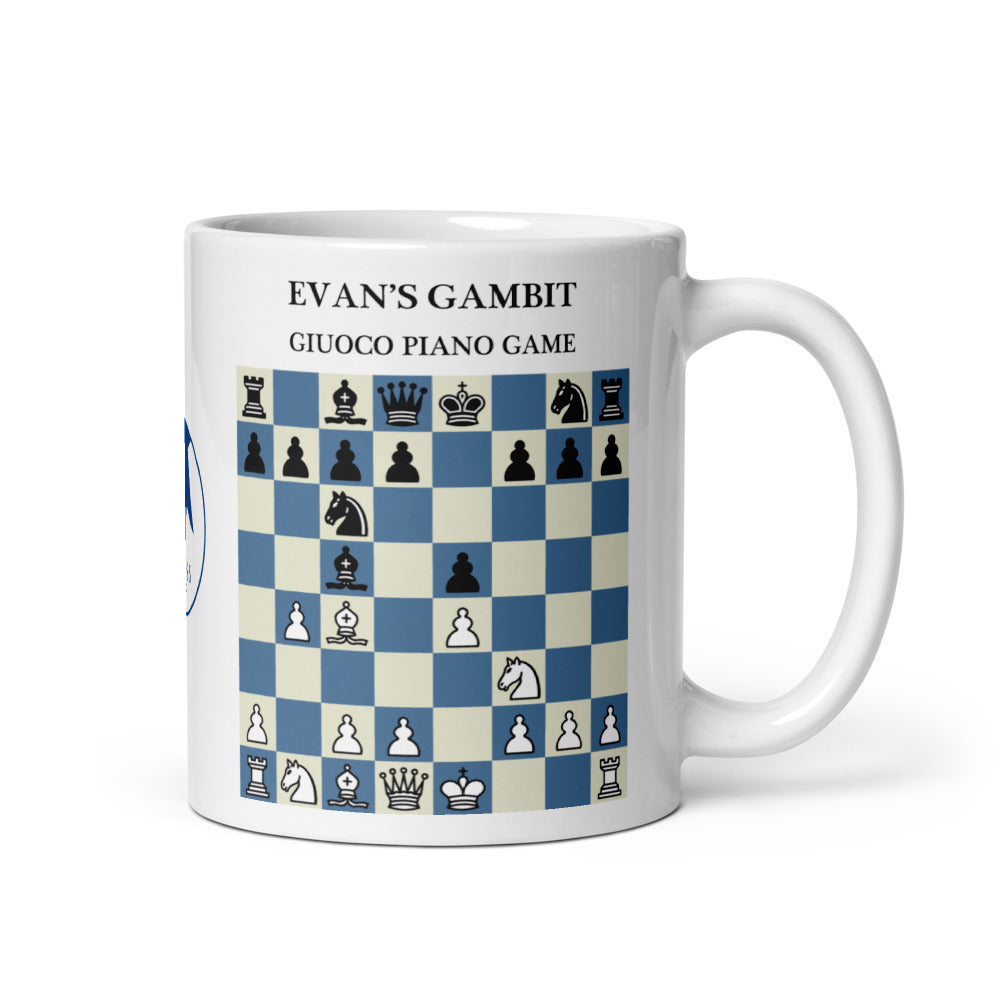
Evan's Gambit Chess Mug
Anchor your attacking repertoire over your morning coffee with the timeless 1.e4 e5 2.Nf3 Nc6 3.Bc4 Bc5 4.b4 sacrificial diagram showcased on premium ceramic drinkware.
CLAIM YOUR REPERTOIRE MUG →Cultivating sharp opening recall requires daily sensory reinforcement. Starting your tactical preparation with the official Evan's Gambit Chess Mug transforms routine morning caffeine into a dedicated theoretical ritual, sharpening the predatory attacking instincts required to dismantle passive opponents.
The Classical Mainline with 5...Ba5: Center Clashes and the Richardson Attack
For nearly two centuries, retreating the bishop with 5...Ba5 has been regarded as Black's most critical challenge. By keeping the bishop on the e1-a5 diagonal, Black prevents White from freely capturing on d4 with the c-pawn without calculations involving pins. White's programmatic reply is immediate and uncompromising:
6.d4 exd4
At this juncture, White possesses two elite pathways that define the modern treatment of the Evans Gambit:
- The Rapid Castle and Normal Position: 7.O-O d6 8.cxd4 Bb6: White completes kingside development and regains pawn equilibrium in the center. White's pawn duo on d4 and e4 commands immense space, restricting Black's minor pieces while preparing dynamic thrusts like d5 or e5.
- The Ultra-Aggressive Richardson Attack: 7.O-O d6 8.Qb3!: White dispenses with recapturing the pawn immediately, aiming both major guns directly at the tender f7 square. Black is forced to defend with 8...Qe7 or 8...Qf6, leading to acute tactical skirmishes where White mobilizes with 9.e5! dxe5 10.Ba3!, severing Black's ability to castle kingside and trapping the black monarch in the open center.
When navigating this classical mainline, White must prioritize piece velocity over raw material arithmetic. Even if Black manages to retain an extra pawn, White's command of the a2-g8 diagonal, the open e-file, and coordinated queenside pressure generates long-term compensation that suffocates Black's plans.
The Compromised Defense: Sacrificing Three Pawns for Total King Paralysis
One of the most thrilling chapters in chess lore occurs when Black greedily consumes every pawn White offers in the center. This line, famously known as the Compromised Defense, arises after:
5...Ba5 6.d4 exd4 7.O-O dxc3!?
Black is now three full pawns ahead. In exchange, Black has made seven consecutive pawn and bishop moves, leaving their entire kingside and queenside undeveloped. White strikes with surgical precision:
8.Qb3 Qf6 9.e5 Qg6 10.Nxc3 Nge7 11.Ba3!
The resulting position is a masterclass in dynamic compensation. Look at the board: White has every single minor piece developed to an active attacking post. The bishop on a3 cuts off ...O-O entirely along the a3-f8 diagonal. The rooks are primed to infiltrate along the semi-open d-file and b-file. Black's king is pinned helplessly on e8, while the knight on e7 is immobilized. Grandmaster practice and neural network evaluations confirm that White's devastating lead in development gives them a winning initiative despite the three-pawn deficit.
Tartakower Variation (5...Be7) and the Direct Retreat (5...Bc5)
Grandmasters who seek to avoid the ferocious tactical minefields of the open diagonals often opt for alternative bishop retreats on move five.
The Tartakower Variation: 5...Be7
Pioneered by Grandmaster Savielly Tartakower, 5...Be7 seeks a calm, compact defensive shell reminiscent of the French Defense:
1.e4 e5 2.Nf3 Nc6 3.Bc4 Bc5 4.b4 Bxb4 5.c3 Be7 6.d4
White immediately challenges the center. If Black attempts to counterattack with 6...Na5, White does not trade bishops passively. Instead, White plays 7.Be2! exd4 8.Qxd4! Nf6 9.e5 Nc6 10.Qh4 Nd5 11.Qg3, seizing rapid initiative against Black's weakened kingside while Black's offside knight on a5 remains stranded on the board rim. If Black instead captures with 6...exd4, White simply recaptures with 7.cxd4 d6 8.Qb3!, maintaining permanent central domination.
The Direct Retreat: 5...Bc5
If Black simply steps back to c5 with 5...Bc5, White does not hesitate:
6.d4 exd4 7.cxd4 Bb4+ 8.Bd2! Bxd2+ 9.Nbxd2
By trading dark-squared bishops, White eliminates Black's active piece while maintaining a colossal pawn center with pawns on d4 and e4. White castles rapidly, drives the black knight away with d5, and launches an overwhelming kingside attack down the semi-open files.
Lasker's Defense: Emanuel Lasker's Pawn-Returning Neutralizing System
The second World Champion, Emanuel Lasker, was renowned for his profound pragmatic psychology. Observing that White's attacking initiative in the Evans Gambit relies entirely on the dynamic momentum of the pawn center and open diagonals, Lasker proposed a brilliant antidote: return the extra gambited pawn at the precise moment to liquidate White's attacking pieces into an equalized or slightly favorable endgame.
Lasker's Defense begins with:
5...Ba5 6.d4 d6 7.O-O Bb6! 8.dxe5 dxe5 9.Qxd8+ Nxd8 10.Nxe5 Be6!
Notice the transformation. Black has returned the b-pawn, Queens have been exchanged, White's explosive central wedge has been dismantled, and Black's minor pieces have successfully developed to neutral posts. For over half a century, this variation was believed to sound the death knell of the Evans Gambit.
However, modern master preparation has discovered energetic continuations for White. Rather than entering Lasker's sterile endgame with 8.dxe5, White plays 8.Qb3! Qd7 9.dxe5 Bb6 10.Rd1! or adopts the subtle positional waiting move 8.a4!, maintaining tension on the board and forcing Black to calculate under sustained pressure.
Evans Gambit Declined: Punishing 4...Bb6 with Queenside Space Expansion
Intimidated by the legendary attacking heritage of the gambit, many players with Black choose to decline the sacrificial pawn altogether on move four:
1.e4 e5 2.Nf3 Nc6 3.Bc4 Bc5 4.b4 Bb6
While declining the gambit avoids immediate tactical carnage, it hands White an effortless positional advantage. Far from being satisfied with passive equality, White immediately exploits the exposed geometry of Black's queenside:
5.a4! a6
If Black plays carelessly with 5...a5?, White locks the bishop out with 6.b5 Nd4 7.Nxd4 Bxd4 8.c3 Bb6 9.d4, securing absolute central command. After the correct 5...a6, White continues with:
6.Nc3 Nf6 7.Nd5! Nxd5 8.exd5 Nd4 9.a5 Ba7 10.d6!
This positional pawn sacrifice of 10.d6! completely fractures Black's pawn chain, isolates the d7 pawn, and paralyzes Black's ability to develop the light-squared bishop. Throughout this comprehensive evans gambit chess guide, the lesson remains constant: timid retreats against White's bold opening initiative only concede deeper strategic strangleholds across the entire board.
Master Analytical Matrix: Key Variations and Tactical Objectives
To navigate every critical branch of the Evans Gambit with master precision, consult this analytical breakdown of essential variations, ECO classifications, and core strategic goals:
| Variation Name | ECO Code | Defining Move Sequence | Strategic Character | White's Core Objective |
|---|---|---|---|---|
| Classical Mainline | C52 | 1.e4 e5 2.Nf3 Nc6 3.Bc4 Bc5 4.b4 Bxb4 5.c3 Ba5 6.d4 | Dynamic tension, central clash | Establish d4-e4 pawn center, castle rapidly, and target f7 via Qb3. |
| Compromised Defense | C52 | 5...Ba5 6.d4 exd4 7.O-O dxc3 8.Qb3 Qf6 9.e5 Qg6 10.Nxc3 | Ultra-sharp sacrificial warfare | Paralyze Black's king on e8, utilize the Ba3 diagonal cut, and mate in the center. |
| Tartakower Defense | C51 | 5...Be7 6.d4 Na5 7.Be2! exd4 8.Qxd4 Nf6 | Solid positional maneuvering | Exploit Black's offside knight on a5 and attack kingside dark-square weaknesses. |
| Lasker's Defense | C52 | 5...Ba5 6.d4 d6 7.O-O Bb6 8.Qb3! Qd7 9.dxe5 | Endgame transition contest | Bypass premature queen trades, maintain center tension, and infiltrate the queenside. |
| Evans Gambit Declined | C51 | 4...Bb6 5.a4 a6 6.Nc3 Nf6 7.Nd5! Nxd5 8.exd5 | Queenside spatial clamp | Trap the dark-squared bishop, disrupt pawn development with 10.d6!, and dominate the center. |
Frequently Asked Questions About the Evans Gambit
What is the core strategic purpose behind sacrificing the b-pawn in the Evans Gambit?
The central purpose of 4.b4! is economic time-and-space conversion. White sacrifices a flank pawn to deflect Black's dark-squared bishop from c5, gain a crucial tempo with 5.c3, build an unshakeable pawn center with 6.d4, and open lethal diagonal attacking channels along a3-f8 and a2-g8 for an immediate assault against Black's king.
Is the Evans Gambit still considered sound against modern computer chess engines?
Yes. While neural engines like Stockfish and Leela Chess Zero defend with superhuman resourcefulness, their objective evaluation of the mainline Evans Gambit consistently hovers near dynamic equality. In practical human play, the burden of calculation falls almost entirely on Black, making the Evans Gambit one of the most effective attacking weapons in tournament chess.
How should Black respond to 4.b4 to achieve maximum solidity?
For players seeking to neutralize White's initiative with minimal tactical risk, Lasker's Defense (5...Ba5 6.d4 d6 7.O-O Bb6! 8.dxe5 dxe5 9.Qxd8+ Nxd8) offers an efficient path by returning the gambited pawn to force queen exchanges. Alternatively, Tartakower's 5...Be7 provides a solid, compact formation that resists White's early diagonal traps.
What happens if Black declines the gambit with 4...Bb6?
Declining the gambit with 4...Bb6 allows White to seize queenside space immediately with 5.a4! a6 6.Nc3 Nf6 7.Nd5!. White cramps Black's minor pieces, frequently plays the disruptive positional wedge 10.d6!, and maintains a commanding grip on the center without having risked any material.
Keep Your Repertoire in Sight
41 ceramic mugs printed to order, each with the name and diagram of a classic opening.