
The Scotch Game: How to Crush 1...e5 and Dominate the Center
If you are a 1.e4 player, you know the frustration of facing 1...e5. You bring your Knight out to f3, they defend with Nc6, and now you have to make a choice. If you play the Ruy Lopez (3.Bb5), you are diving into thousands of pages of heavy theory. If you play the Italian Game (3.Bc4), you often end up in slow, maneuvering positional battles.
But what if you want to attack right now? What if you want to blow the center of the board wide open on move three? Enter The Scotch Game. Championed by legendary attacking players like Garry Kasparov, the Scotch Game is a ruthless, dynamic opening that forces Black to defend accurately from the very beginning.
♟️ Quick Answer: What is the Scotch Game?
The Scotch Game is an aggressive chess opening for White characterized by the moves 1. e4 e5 2. Nf3 Nc6 3. d4. By pushing the d-pawn to d4 immediately, White eliminates the central pawn tension, opens diagonals for both bishops, and aims to dominate the center with active piece play. It leads to open, tactical middlegames where calculation is more important than slow maneuvering.
1. Why Play the Scotch Game?
The psychological impact of 3.d4 cannot be understated. Black usually plays 1...e5 to establish a firm grip on the center. By immediately breaking that grip, White says, "We are playing my game today."
- Immediate Space: After the inevitable exchange (3...exd4 4.Nxd4), White gets a beautifully centralized Knight on d4.
- Free Bishops: Both the light-squared and dark-squared bishops have clear, unobstructed diagonals.
- Less Theory, More Tactics: Unlike the Ruy Lopez, you don't need to memorize 20 moves of theory. If you understand the tactical motifs and attacking patterns, you can crush opponents who only know how to play defensively.
The Attacker's Choice: The Scotch Game Mug
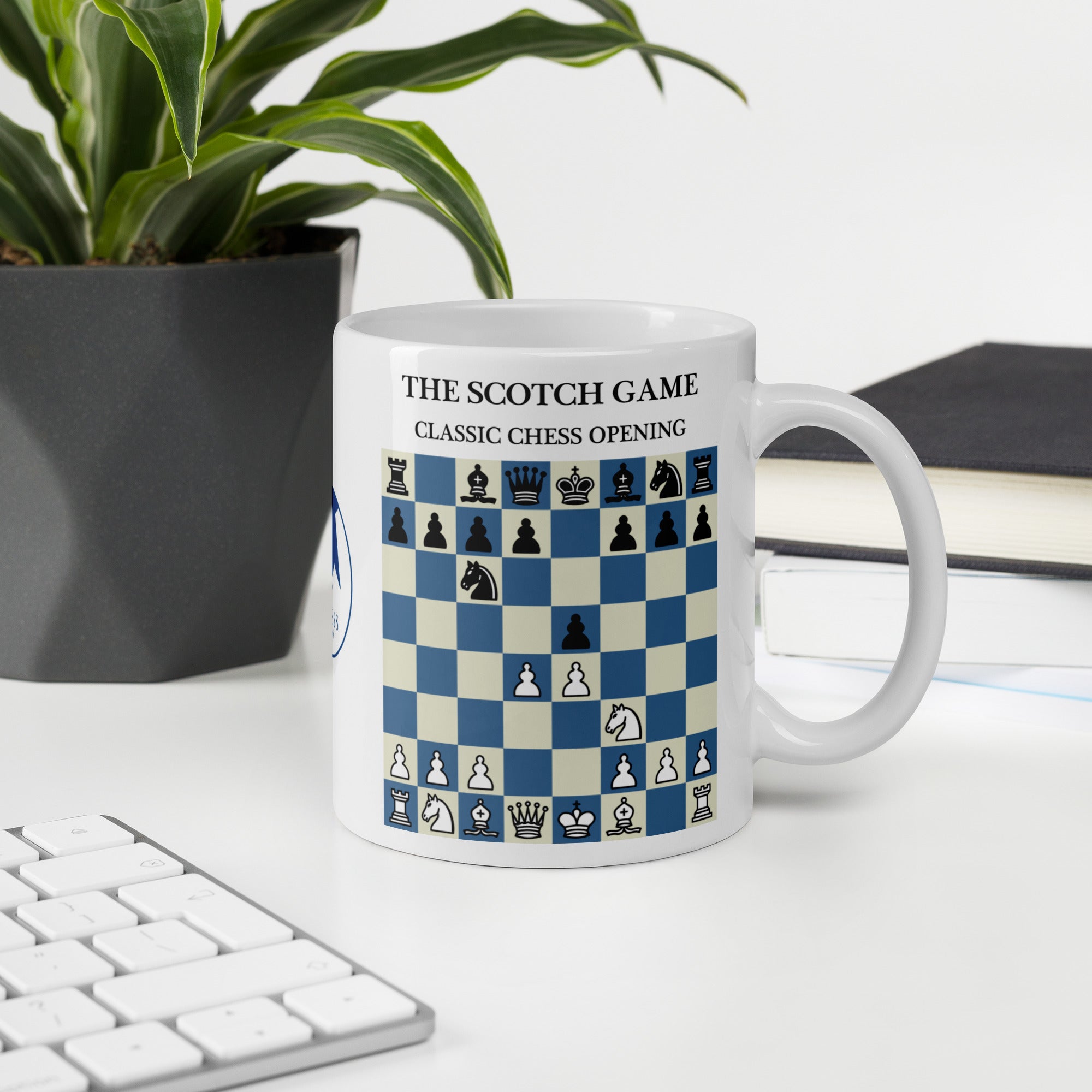
Show your opponents you mean business from move three. Perfect for the aggressive 1.e4 player, our Scotch Game Mug features the critical starting position of this fierce opening. Start your morning with a clear plan of attack.
GET THE SCOTCH MUG2. The Main Lines Explained
After the initial moves (1.e4 e5 2.Nf3 Nc6 3.d4 exd4 4.Nxd4), Black has two main ways to challenge White's centralized Knight. Here is what you need to know about both.
| Variation Name | Black's Move | The Position's Character |
|---|---|---|
| The Classical Variation | 4... Bc5 | Black immediately attacks the Knight on d4. White usually defends with 5.Be3, preparing to develop the Queen to d2 or f3. Leads to sharp, tactical struggles where both kings are often under pressure. |
| The Schmidt Variation | 4... Nf6 | Black develops naturally and attacks the e4 pawn. This often transitions into the highly complex Mieses Variation if White chooses to play aggressively with 5.Nxc6 bxc6 6.e5. |
| The Steinitz Variation | 4... Qh4!? | A very tricky, aggressive sideline by Black targeting the e4 pawn and f2 square immediately. White must know the exact theoretical response (5.Nb5 or 5.Nc3) to avoid an early disaster. |
3. Deep Dive: The Ferocious Mieses Variation
If you want to play the Scotch like Garry Kasparov, you must master the Mieses Variation. After 1.e4 e5 2.Nf3 Nc6 3.d4 exd4 4.Nxd4 Nf6, White plays 5.Nxc6 bxc6 6.e5.
This pawn push to e5 is an absolute nightmare for unprepared Black players. It kicks the Knight away from f6, usually forcing Black to play the awkward 6...Qe7 to pin the pawn. The resulting positions are incredibly imbalanced. White will castle queenside, Black's pawn structure on the queenside is ruined, and the game becomes a race to checkmate.
4. How to Train Your Scotch Tactics
Because the Scotch Game creates open centers and rapid piece development, tactics flow naturally from the position. However, to spot a winning sacrifice on f7 or a fork on c7, you need impeccable 3D visualization.
Visualize the Attack on a Premium Board
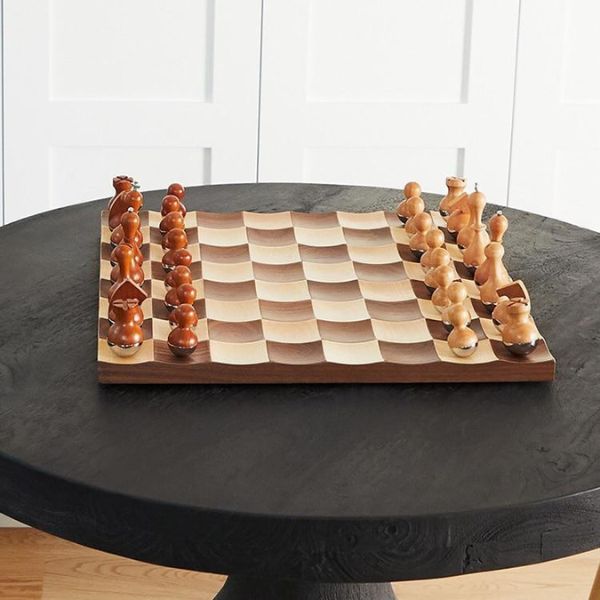
You cannot master the Mieses variation by just clicking arrows on a screen. Set up the complex middlegame positions on our Luxury Wooden Chess Board. Calculating deep attacking lines with physical, weighted pieces trains your brain to find the crushing blows during real OTB tournaments.
UPGRADE YOUR STUDY BOARD5. Frequently Asked Questions (FAQ)
In the Scotch Game (3.d4 exd4 4.Nxd4), White immediately recaptures the central pawn with the Knight. In the Scotch Gambit (3.d4 exd4 4.Bc4), White ignores the pawn temporarily to rapidly develop the Bishop and attack the f7 square. Both are excellent, aggressive choices.
Yes! For decades, the Scotch was considered a slightly drawish opening at the grandmaster level. In the 1990s, Garry Kasparov shocked the chess world by using it as a lethal weapon against his greatest rival, Anatoly Karpov, completely revitalizing the opening's reputation.
Absolutely. It teaches beginners the importance of central control, rapid development, and open-game tactics without requiring them to memorize endless opening traps like the Italian Game often does.
Conclusion
The Scotch Game is not for the faint of heart. It is for players who want to take control of the game from move three. Grab your Scotch Game Mug, study the tactical patterns on a physical board, and start punishing 1...e5 players today.