
How to Read and Write Chess Moves (Algebraic Notation Explained)
If you open a chess book or watch a Grandmaster analyze a game, it looks like they are speaking a secret, mathematical language. You will see sequences like 1.e4 c5 2.Nf3 d6 3.d4 cxd4 4.Nxd4 Nf6 5.Nc3 a6. To the untrained eye, it is just a random string of letters and numbers.
This is called Algebraic Notation. It is the universal language of chess. Once you understand the simple rules behind it, you will be able to read any chess book, analyze your own games, and legally record your moves in official Over-The-Board (OTB) tournaments. In this guide, we will decode this system step-by-step so you can read and write chess moves with complete confidence.
♟️ Quick Answer: How do you read chess notation?
Chess notation combines the Piece Symbol (capital letter) with the Destination Square (lowercase letter and number). The board is a grid: letters a-h represent the columns (files) and numbers 1-8 represent the rows (ranks). For example, Nf3 means the Knight (N) moved to the f3 square. If there is no capital letter (e.g., e4), it means a pawn moved. An "x" indicates a capture (e.g., Bxc6 means Bishop captures on c6).
1. The Grid: Files and Ranks
Before you can write a move, you need to know where the piece is going. The chessboard is an 8x8 grid, functioning exactly like a simple map or a game of Battleship.
- Files (Columns): Running vertically up and down the board, the files are labeled with lowercase letters from a to h (reading from White's left to right).
- Ranks (Rows): Running horizontally across the board, the ranks are numbered from 1 to 8. The 1st rank is where White's major pieces start, and the 8th rank is where Black's major pieces start.
Every square is the intersection of a file and a rank. For example, the bottom-left corner square from White's perspective is a1. The center squares are d4, d5, e4, and e5.
2. The Piece Symbols (Why Knight is "N")
Every piece is represented by a single Capital Letter. The only exception is the Pawn, which has no letter at all.
| Piece | Symbol | Notation Example |
|---|---|---|
| King | K | Ke2 (King moves to e2) |
| Queen | Q | Qh5 (Queen moves to h5) |
| Rook | R | Rd1 (Rook moves to d1) |
| Bishop | B | Bc4 (Bishop moves to c4) |
| Knight | N | Nf3 (Knight moves to f3. "K" is already taken by the King!) |
| Pawn | (None) | e4 (The e-pawn moves to e4) |
3. Captures, Checks, and Checkmates
When pieces interact, we add specific symbols to the notation to tell the story of the game.
- Captures ( x ): If a piece captures another, we use a lowercase "x". For example, Rxd4 means the Rook captured whatever enemy piece was sitting on the d4 square.
- Pawn Captures: Because pawns do not have capital letters, we state the file the pawn came from, then "x", then the destination. If the e-pawn captures a piece on d5, it is written as exd5.
- Check ( + ): If a move places the enemy King in check, add a plus sign at the end. Example: Qh5+.
- Checkmate ( # ): If the move ends the game in checkmate, add a hashtag. Example: Qxf7# (Queen captures on f7, delivering checkmate).
4. Special Moves: Castling and Promotion
There are a few unique moves in chess that require their own special notation codes.
- Kingside Castling: Written as O-O (two capital letter O's).
- Queenside Castling: Written as O-O-O (three capital letter O's).
- Pawn Promotion: If a pawn reaches the end of the board, you write the move, an equal sign, and the piece it becomes. Example: e8=Q (Pawn moves to e8 and promotes to a Queen).
- En Passant: This rare pawn capture is noted normally (e.g., exd6), but you can optionally add "e.p." at the end for clarity: exd6 e.p.
5. Why You Must Learn Notation on a Physical Board
If you only play online, you will never truly learn algebraic notation. The computer highlights the squares and writes the moves in a sidebar for you. When you sit down at an official tournament, your brain will freeze trying to figure out if you are writing down c4 or f5.
Train Your Spatial Awareness
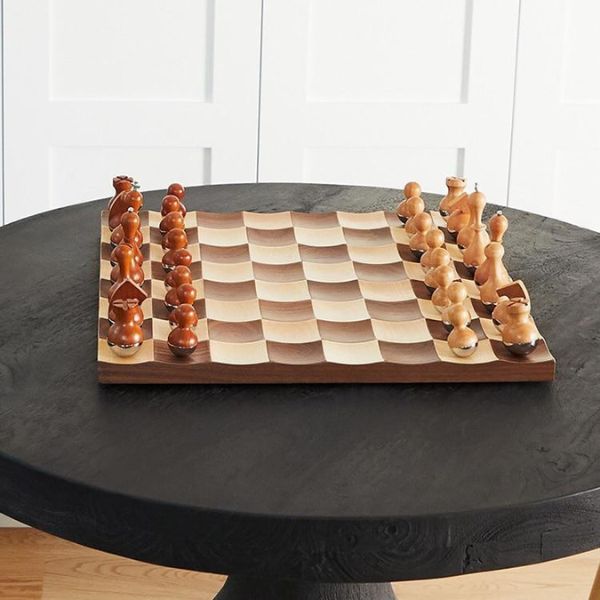
The fastest way to memorize the coordinates is to play out famous games on a physical board without labels. Our Luxury Wooden Chess Board features a pristine, tournament-standard grid. Without relying on digital crutches, your brain is forced to internalize the map of the board.

Grab a notebook, set up our Luxury Wooden Chess Pieces, and practice writing down both sides of a game. Once you connect the physical touch of moving a heavy wooden piece with the act of writing the notation, it becomes permanent muscle memory.
UPGRADE YOUR STUDY SETUP6. Frequently Asked Questions (FAQ)
Punctuation marks are added by human analysts or computers to evaluate the quality of a move. A single exclamation mark (!) means a good or strong move. A double exclamation mark (!!) indicates a brilliant, often game-winning move.
A question mark (?) indicates a bad move or a mistake. A double question mark (??) signifies a massive blunder that likely loses the game. A combination mark (!?) means the move is interesting and aggressive, but objectively risky.
This is called disambiguation. If both your Knights can jump to the d4 square, you must specify which one moved. You add the file it came from. For example, if the Knight on the f-file moved, you write Nfd4. If they are on the same file, you use the rank (e.g., N3d4).